



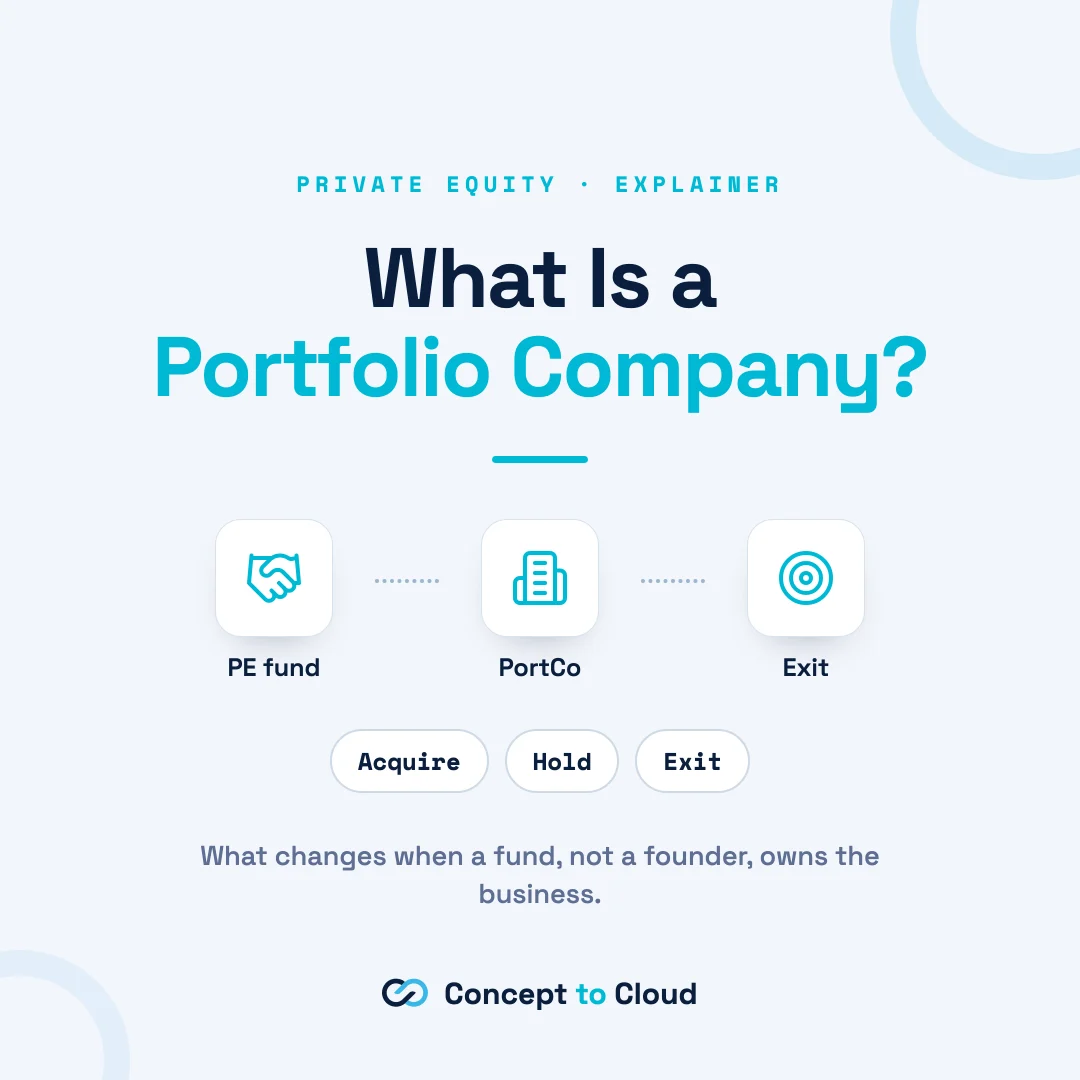
Short answer. A portfolio company is a business that a private equity firm, venture capital fund, or other investment firm owns a stake in. The “portfolio” is the investor’s collection of such companies, the way a stock portfolio is a collection of shares. In private equity the stake is usually a controlling one, the ownership has a clock on it, and the business is run to be sold again, typically within three to seven years. Inside the industry, the working shorthand is “portco.”
Who actually owns a portfolio company?
The fund does, and the fund is itself owned by its investors. A private equity firm raises money from limited partners (pension funds, endowments, insurers, family offices) into a fund, and the fund buys the companies. The firm’s partners manage the fund and typically invest alongside it. Management teams usually hold equity too, often rolled over from the purchase, so the people running the company have a stake in the exit. Practical consequence: the CEO of a portfolio company answers to a board the fund controls, and the fund answers to investors who expect their money back, with returns, on a schedule.
What is the difference between a portfolio company and a subsidiary?
Ownership intent. A subsidiary is owned by an operating parent that keeps it to serve the parent’s strategy, usually indefinitely. A portfolio company is owned by a financial investor that intends to sell it, and every major decision runs through that lens. A subsidiary might be kept for decades because it feeds the parent’s product line; a portfolio company is improved, grown, and exited. Same legal machinery of ownership, entirely different clock.
What changes when a company becomes a portfolio company?
Five things, usually within the first quarter. The board changes: fund partners take seats, and an operating partner may arrive with real authority. Reporting changes: monthly packs with numbers the fund’s model cares about, produced on a discipline most founder-run companies never needed. A value creation plan appears, turning the deal thesis into named initiatives with owners and dates. Debt usually appears too, since most PE deals are partly financed by borrowing against the company itself. And the time horizon changes everything downstream of it: investments that pay back in year six of a five-year hold do not get made.
What does the lifecycle look like?
Acquire, hold, exit. The fund buys the company, often alongside management. The hold period, typically three to seven years, is where the value creation plan runs: grow revenue, expand margins, fix what suppresses the multiple. The exit returns the capital: a sale to another company, a sale to another fund, or occasionally a listing. The same business can be a portfolio company several times in a row, passing from fund to fund, each owner underwriting a new round of improvement.
Where does technology fit?
For a growing share of portfolio companies, the technology platform is the value creation plan, or the thing quietly blocking it. It is also the part of the business a buyer’s diligence team will read hardest at exit. That intersection, what funds should check before buying and fix while holding, is what we cover in the operating partner’s technology playbook and do in practice for private equity clients.
Ex-NASA engineer and cloud architect with over a decade of experience building scalable systems for startups and enterprises.
Work with Tom →