



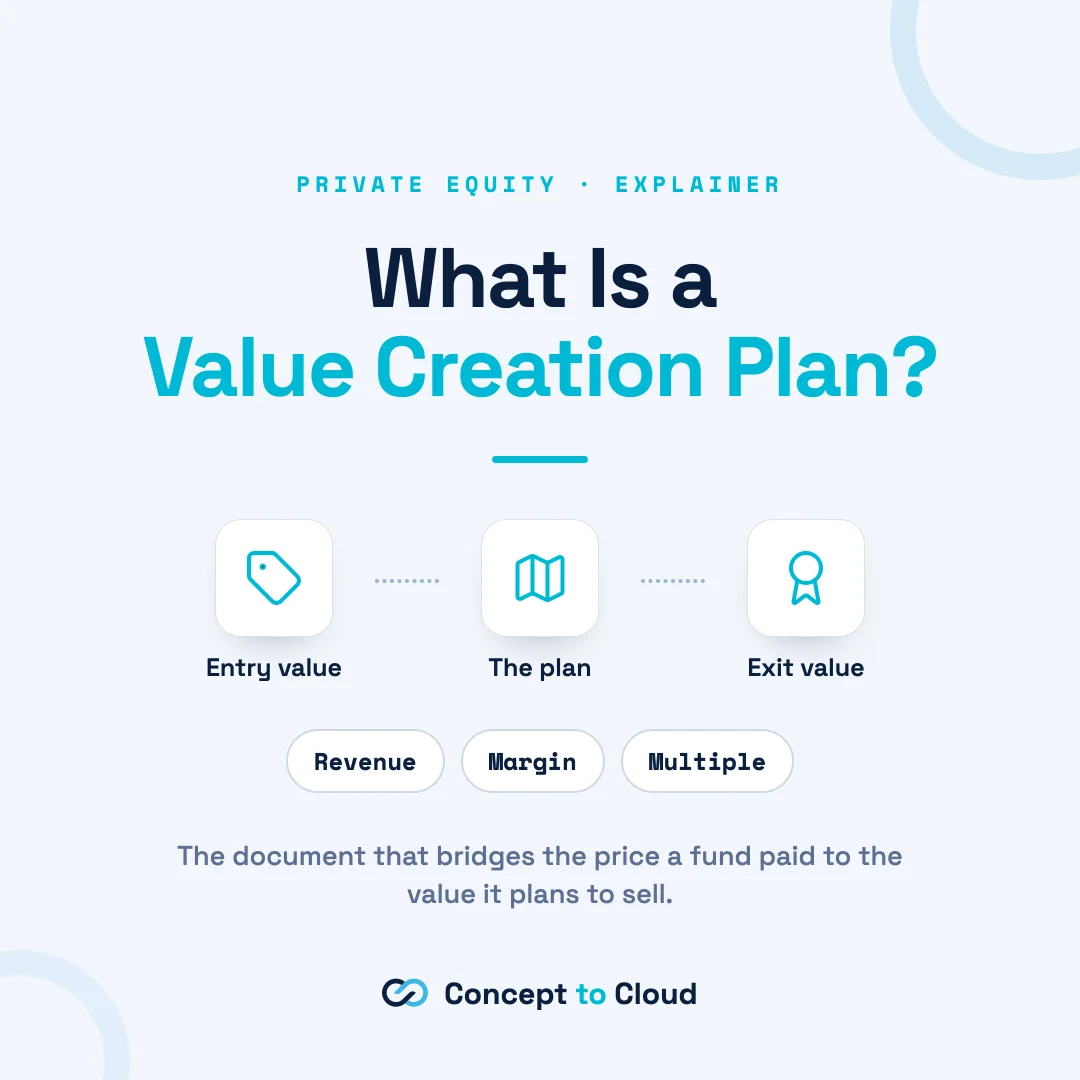
Short answer. A value creation plan (VCP) is the working document that lists the specific initiatives meant to take a portfolio company from the price the fund paid to the value it plans to sell at. Not a strategy deck: a list of named initiatives, each with an owner, an investment cost, an expected earnings impact, and a date. It is drafted during diligence, hardened in the first 100 days after close, and reviewed at every board meeting until exit.
What goes in a value creation plan?
Five things, and the discipline is that all five exist for every initiative. The initiative itself, stated concretely (“consolidate the three billing systems,” not “operational excellence”). A named owner inside the company. The investment required. The expected impact on earnings or on the exit multiple, as a number. And the timeline, with the milestone that proves it is working. A typical mid-market VCP carries somewhere between five and fifteen initiatives; more than that usually means nobody prioritized.
The plan also carries its baselines: the current numbers each initiative is supposed to move. A VCP without baselines cannot fail, which is exactly why weak ones omit them.
What are the three levers of value creation?
Every initiative in a VCP pulls one of three levers. Revenue growth: pricing, new segments, sales productivity, add-on acquisitions. Margin expansion: procurement, automation, offshoring or reshoring, technology cost. And multiple expansion: making the business worth more per dollar of earnings at exit than at entry, through recurring revenue mix, customer concentration fixes, or a technology story a buyer will pay up for. Funds underwrite mostly the first two; the third is where good holds outperform their model.
Who owns the value creation plan?
The management team delivers it, the operating partner shepherds it, and the board holds everyone to it. The clean division: the CEO owns each initiative’s delivery, the operating partner owns the plan’s integrity (real baselines, honest RAG statuses, initiatives killed when they stop earning their place), and the deal partner owns the link back to the returns model. When a VCP has no single person keeping it honest, it degrades into board theater within two or three quarters.
When is it written?
Three passes. During diligence it exists as hypotheses: the deal team underwrites the price partly on what they believe can be improved. In the first 100 days it becomes commitments, tested against what the new owners actually found inside. And mid-hold it gets refreshed, because plans age: initiatives complete, markets move, and the exit story firms up. A VCP unchanged after two years is not stable, it is abandoned.
Where does technology sit in a value creation plan?
Increasingly, everywhere: it is often the largest single investment line and the one most likely to be underwritten on hope. Platform modernization so the roadmap can actually ship, data work that makes the AI initiatives real rather than decorative, and the pre-exit cleanup that keeps a buyer’s technical diligence from repricing the deal. The technology version of the VCP arc is what our operating partner’s technology playbook covers, and the delivery side is what we do for private equity clients.
Why do value creation plans fail?
Three patterns account for most of it. Initiatives without baselines, so nothing can ever be off-track. Ownership spread across “the team,” so nothing is anyone’s fault. And plans built to impress the investment committee rather than to run the company, which read beautifully and change nothing. The test of a real VCP is unglamorous: can the board meeting open with one page showing each initiative, its number, and whether it moved?
Ex-NASA engineer and cloud architect with over a decade of experience building scalable systems for startups and enterprises.
Work with Tom →