



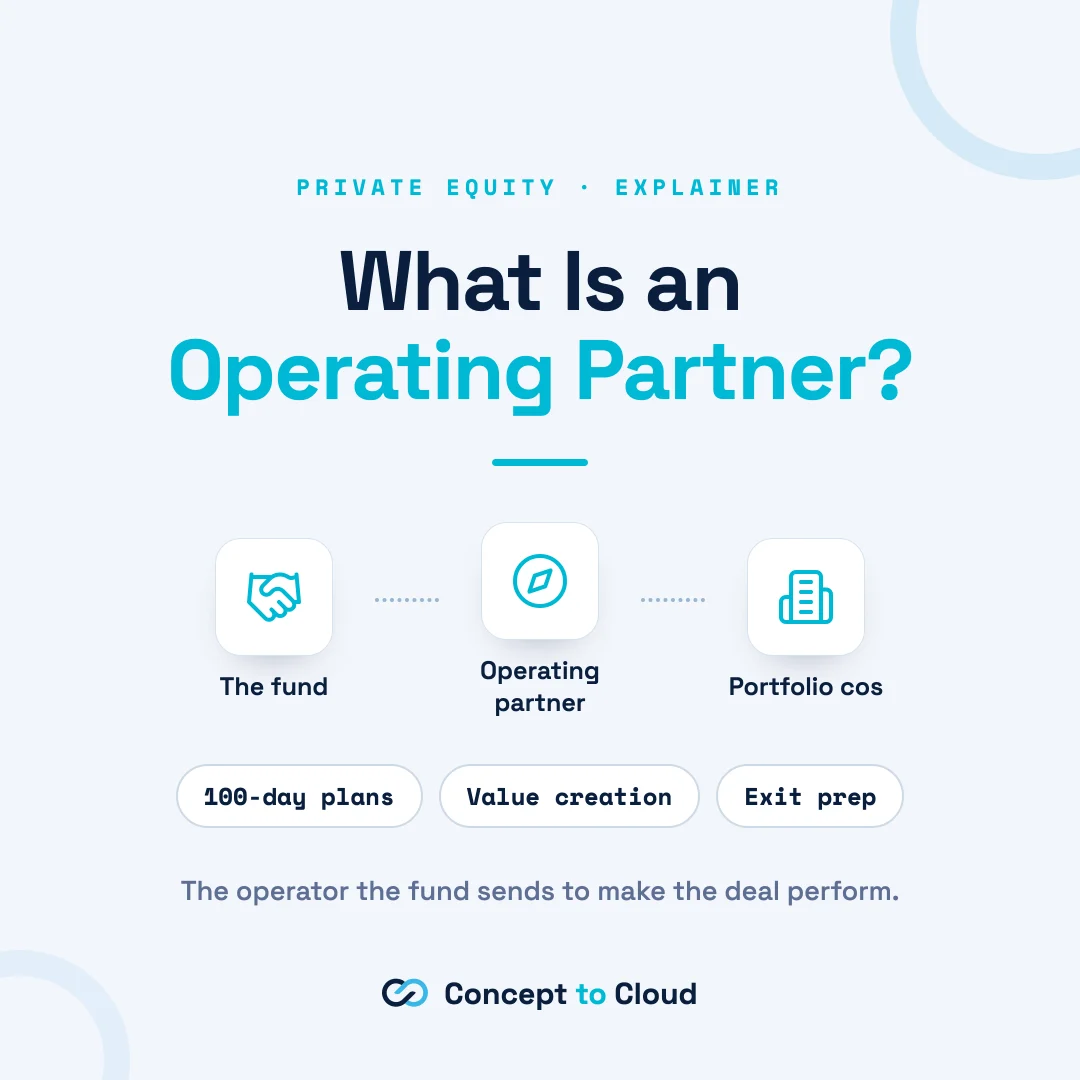
Short answer. An operating partner is a senior executive employed by a private equity firm to improve the companies the fund owns, rather than to find or finance deals. Deal partners buy the business; operating partners make the investment thesis come true, through 100-day plans, value creation plans, executive hiring, and the unglamorous work of making a portfolio company perform.
What does an operating partner actually do?
The job runs across the whole hold period, and it starts before the fund even owns the company. In diligence, operating partners pressure-test the thesis: can this management team actually deliver the plan the deal team is underwriting? In the first 100 days after close, they drive the transition: new reporting, the value creation plan hardened from diligence hypotheses into commitments, the first leadership changes if the diligence said they were needed.
During the hold, the work becomes portfolio muscle: hiring and replacing executives, negotiating shared procurement across portfolio companies, chasing the initiatives in the value creation plan, and sitting on boards. Before exit, they run the clean-up, making sure a buyer’s diligence pass finds a business that looks the way the equity story says it does. We wrote up the technology side of that arc in the operating partner’s technology playbook.
What is the difference between a deal partner and an operating partner?
A deal partner sources, structures, and closes investments; an operating partner improves the companies after the wire clears. The deal partner’s skill is investment judgment: pricing a business, structuring the debt, winning the auction. The operating partner’s skill is operating judgment: knowing which of the twelve problems inside a company are the two that move enterprise value. In most firms the deal partner still owns the investment and its returns; the operating partner is the instrument for delivering them. The two argue, usefully, in the middle.
Does “operating partner” mean owner?
No. The title borrows “partner” from the firm’s structure, and some operating partners are genuine partners in the fund, but the role does not imply ownership of the portfolio company. Ownership sits with the fund (see who owns a portfolio company). Operating partners typically hold equity incentives, but as compensation, not control.
How do operating partners get paid?
Three models cover most of the market. Fund-level employees get salary plus carried interest in the fund, like deal partners. Deal-specific operating partners get compensation tied to the companies they work on, often co-investment and equity in those deals. And a growing tier work as contracted operators: paid per engagement, brought in for a specific phase like a carve-out or a turnaround. The trend over the last few years has been toward specialists: firms now appoint operating partners for pricing, for talent, and increasingly for data and AI, rather than one generalist covering everything.
What does it mean for a portfolio company when one shows up?
It means the fund thinks the value plan needs more force than board meetings provide. For management teams, the honest read is neither threat nor rescue: a good operating partner brings pattern recognition from a dozen holds, real budget authority, and a direct line to the fund. The friction point is usually pace. Operating partners run on the fund’s clock, which is an exit clock, and initiatives that drift get attention quickly.
The gaps operating partners most often fill from outside are the deep-specialist ones, technology first among them: reading a platform before the deal closes, or fixing the data estate the AI plans depend on. That work, and how we do it for private equity clients, is its own subject.
Ex-NASA engineer and cloud architect with over a decade of experience building scalable systems for startups and enterprises.
Work with Tom →