


Most people pick one AI model, pay the monthly fee, and use it for everything. Planning, writing, code, meeting notes. One subscription, one habit, done.
We wanted to know what that habit costs. So we split building a product into eleven jobs: coming up with ideas, choosing between them, architecture, writing the spec, building the interface, building the logic, copy, review, running the day, reading a codebase, and repairing one.
Then we tested free and paid models against each job and asked one narrow question. What is the cheapest model that does this well?
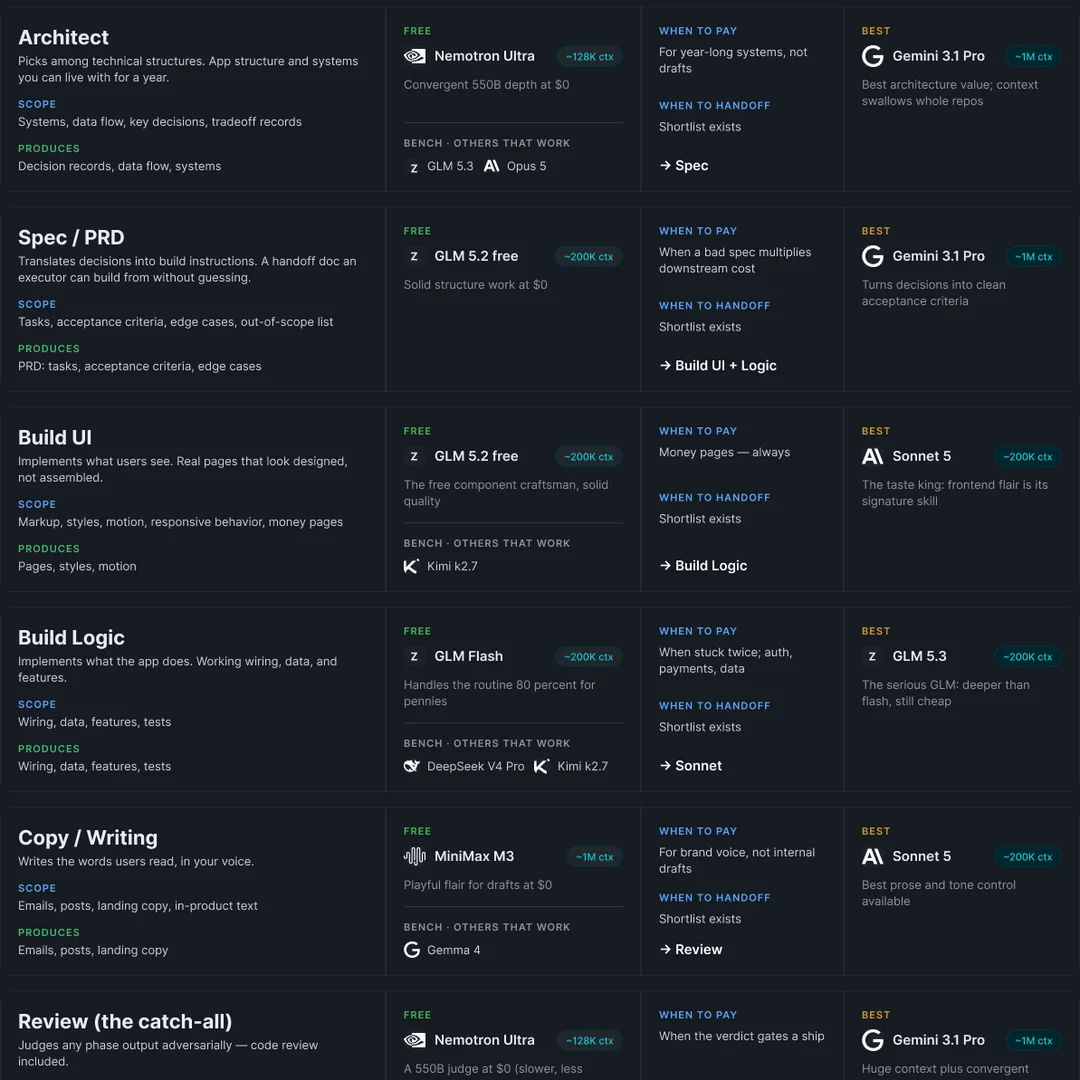
All eleven have a free answer. The interesting question is when to override it. The whole map is on our free AI tools page, one card per phase.
What the free models actually cover
MiniMax M3 handles ideation. It is the only free model we found with real creative flair, and it holds around a million tokens of context, so you can hand it a lot before it loses the thread.
GLM 5.2 free writes specs and builds interfaces at $0. The word free is part of the model name, so pick that exact variant rather than the nearest match. Not rough drafts either. Component work you can use.
GLM Flash does the routine wiring, data and features for pennies a turn.
Nemotron Ultra is a 550 billion parameter model that will sit there and judge your work for nothing. It is slower than the paid options and less nuanced. It is also free.
That covers most of building a product without a card on file.
Where paying is worth it
Every phase has its own trigger on the map. Four of them come up most.
Money pages. Anything a customer pays through goes to Sonnet 5, because frontend taste is the thing it is unusually good at.
Decisions you cannot reverse. Architecture you will live with for a year goes to Gemini 3.1 Pro, whose context window swallows whole repos. The same model judges tradeoffs at around $2, cheap enough to run daily.
Specs, when a bad one multiplies downstream. A vague spec costs more three months later than the model costs now.
Anything that can lose work. Repo surgery, git history, recovery. Sonnet 5 is careful with diffs and does not get creative at bad moments.
Now look at what is missing from that list. Reading a codebase never justifies paying. Internal drafts do not either, though brand voice does. Day to day coordination is almost never worth it, and only for the structural calls.
The rule
Let the cheap models build it. Let the expensive ones review it.
Free models are good at the 80 percent: the drafts, the wiring, the routine work. Judgement is where you spend. A free model can write the code. A paid model should decide whether it ships.
The trade you are making
Free tiers often use your prompts for evaluation. That is the deal for $0, and it is a fine deal for drafts, repos you own, and routine work. Keep client-confidential material out of them, or route those prompts through a paid tier.
This is the same question that decides whether an AI project works at all: what data are you handing over, and do you know where it goes. We have written about that before in why your AI project is actually a data project.
Trying it
OpenRouter puts every model behind one account, free tiers and paid ones side by side, so switching is a dropdown rather than a migration.
Pick the job you do most. Run it on the free model from the map for a week. See whether you notice.
Research and model testing by Amelia Prasad.
Ex-NASA engineer and cloud architect with over a decade of experience building scalable systems for startups and enterprises.
Work with Tom →